
3 Systems Every CRE Team Needs Before They Scale
Most commercial real estate teams try to scale before their backend is ready for it.
More brokers. More deals. More marketing. But no system to hold it all together. The result is predictable: more chaos, more dropped balls, and more hours spent on things that should have been automated three months ago.
We see this pattern constantly. A team leader or brokerage owner decides it's time to grow. They bring on a new broker, expand into an adjacent market, or ramp up their marketing. And within 60 days, everything feels harder instead of easier.
The issue is almost never talent or market opportunity. It's infrastructure. The systems that should be running the operational backbone of the business either don't exist or weren't built to handle the next stage of growth.
Here are the three systems every CRE team needs in place before they scale.
1. A CRM That Actually Drives Follow-Through
A CRM is not a contact list. It's a pipeline management system that should be doing the operational heavy lifting of your business.

Most CRE teams have a CRM. Very few have one that's actually configured to drive follow-through. The difference matters. A properly structured CRM has defined pipeline stages from initial prospect through close, automated follow-up sequences that trigger based on deal stage and lead behavior, task management that surfaces the right action at the right time, and reporting dashboards that give you visibility into pipeline health without manual spreadsheet work.
When your CRM is working, your team spends less time wondering who to call next and more time having the conversations that close deals. Lead leakage drops. Response times improve. And the data you need to make decisions is available without anyone building a report from scratch.
The test is simple: can a new broker join your team and know exactly what to do with a lead on day one? If the answer is no, your CRM isn't a system yet. It's a database.
According to industry research from the National Association of Realtors, consistent follow-up is one of the top differentiators between high-producing and average-producing commercial real estate professionals.
2. A Marketing Engine That Runs Without Daily Intervention
Marketing in CRE has a consistency problem. Most teams market when they remember, post when they have time, and measure success by how many likes a post got. That's not a marketing engine. That's a side project.
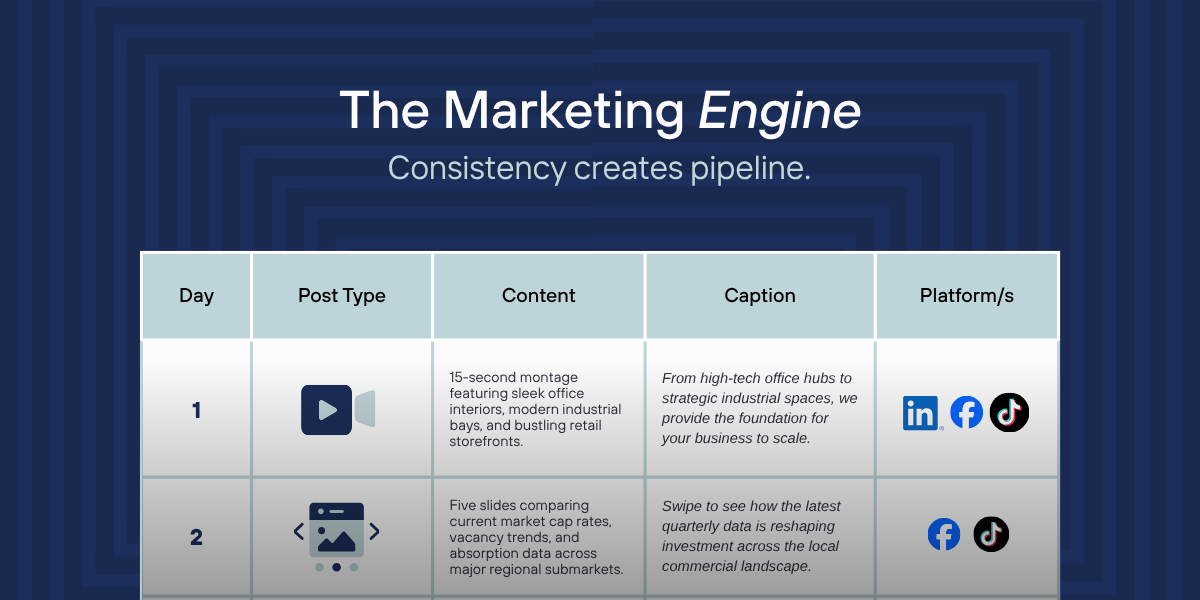
A marketing engine is a structured system that produces content on a predictable cadence, distributes it across the right platforms, and connects every touchpoint to a defined funnel. It includes a content calendar organized around core themes and audience pain points, a production workflow with clear ownership and deadlines, platform-specific distribution adapted to how each audience consumes content, and lead capture mechanisms that convert attention into pipeline opportunities.
The key word is 'engine.' An engine runs. It doesn't wait for someone to start it every morning. When your marketing system is built correctly, content goes out whether or not the founder had a free afternoon. Leads enter a nurture sequence whether or not someone remembered to send the follow-up email.
For CRE teams preparing to scale, this matters because inconsistent marketing creates inconsistent pipeline. And inconsistent pipeline makes it impossible to forecast revenue or justify the cost of bringing on new brokers.
Launch Commercial's content strategy is built on a five-pillar framework: Systems That Scale, Marketing That Converts, Broker Wins & Case Studies, Insights & Education, and Launch Perspective — as defined in the Launch Commercial Brand Strategy.
3. A Reporting Framework That Gives Visibility Into What's Working
You can't improve what you can't see. And most CRE teams can't see nearly enough.

A reporting framework connects your CRM data, marketing performance, and operational metrics into a dashboard that answers the questions that matter. Where is the pipeline strong and where are deals stalling? Which marketing channels are generating the highest-quality leads? How much time is the team spending on admin versus revenue-generating activity? What is the average deal cycle and where are the bottlenecks?
Without a reporting framework, every decision is based on gut feel. With one, you can see which systems are working, which need adjustment, and where the team's time is actually going. That visibility is what separates teams that grow intentionally from teams that grow chaotically.
The reporting framework also becomes the accountability layer for your team. When every broker can see their own pipeline metrics, follow-up rates, and conversion data, performance becomes transparent. And transparency drives improvement.
The concept of Business Analytics and Insights is one of Launch Commercial's five key messaging pillars, as outlined in the Launch Commercial Verbal Identity — turning numbers into insight by connecting marketing, operations, and client data into unified dashboards.
The Compounding Effect
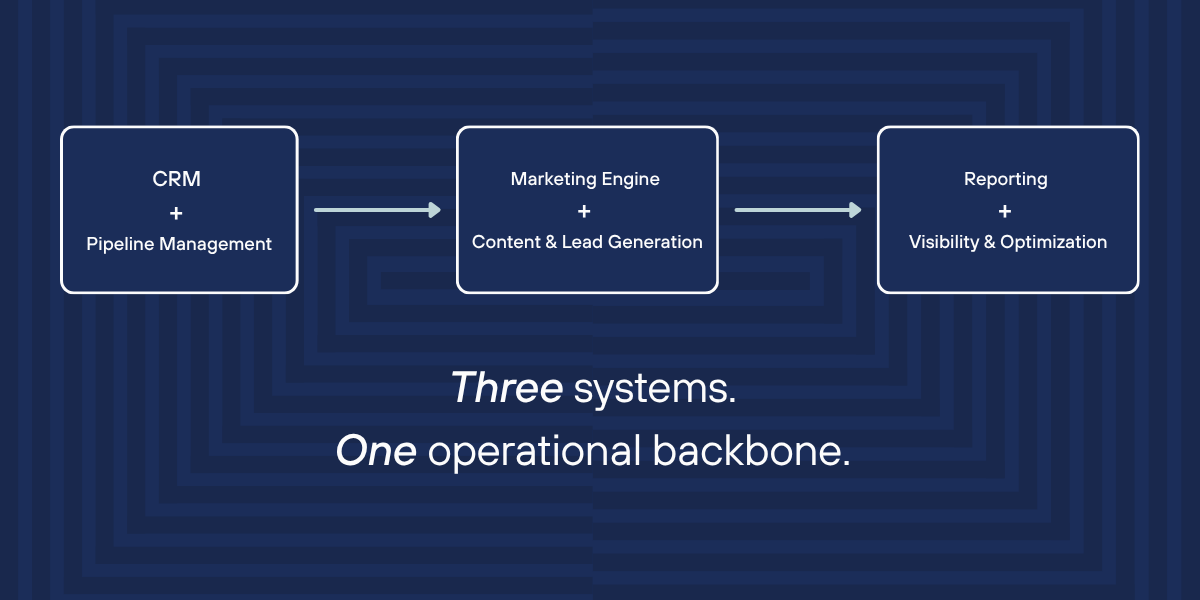
These three systems don't just work individually. They compound. Your CRM feeds data to your reporting framework. Your marketing engine drives leads into your CRM. Your reporting framework tells you which marketing efforts are producing real pipeline, not just impressions.
When all three are connected and running, adding a broker to your team becomes an operational win instead of an operational burden. The new broker inherits the system. They don't have to build one.
That's how scaling should feel. Not harder. Lighter.
Build the Backend Before You Build the Team
If you're a CRE team leader or brokerage owner thinking about growth, the first investment shouldn't be headcount. It should be infrastructure.
Get your CRM configured to drive follow-through, not just store contacts. Build a marketing engine that runs without you. Install a reporting framework that gives you the visibility to make confident decisions.
Then scale.

At Launch Commercial, we build these systems for CRE brokers and teams every day. If you want to see what this looks like for your business, book a demo.